
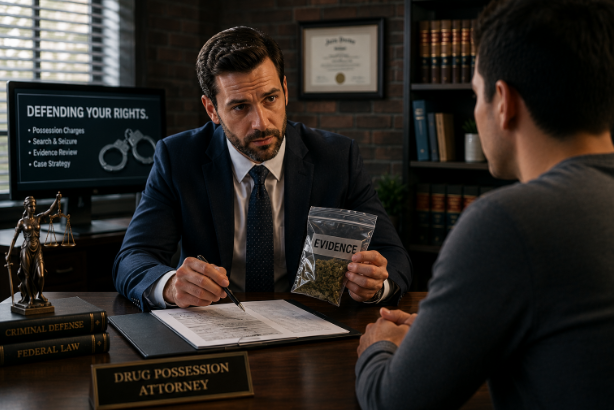
A drug possession charge can create serious concerns about fines, probation, incarceration, employment, professional licensing, and a permanent criminal record. The consequences often depend on the substance involved, the amount allegedly possessed, prior convictions, where the arrest occurred, and whether prosecutors believe the drugs were intended only for personal use or for distribution. Speaking with drug possession attorneys can help defendants understand the charges, review how evidence was obtained, and evaluate the legal options available before making decisions that could affect the outcome of the case.
What Is Considered Drug Possession?
Drug possession generally involves knowingly having control over a controlled substance without lawful authorization.
Possession does not always mean that drugs were found directly in a person's pocket or hand. Depending on the circumstances, prosecutors may allege actual possession or constructive possession.
Actual possession usually refers to a substance found directly on the accused person's body. Constructive possession can involve an allegation that a person knew about the substance and had the ability to exercise control over it, even if it was located somewhere else.
For example, drugs found in a vehicle, residence, backpack, or shared space can raise questions about who actually knew about and controlled the substance.
Experienced drug possession attorneys may examine these facts carefully because physical proximity alone does not always establish knowing possession.
Why Does the Type and Amount of Drug Matter?
Drug offenses are not treated identically.
The classification of the alleged substance and the amount involved can influence the charge and potential penalties. Controlled substances may fall into different schedules or statutory categories, and possession of larger amounts can sometimes lead prosecutors to consider more serious allegations.
Other factors may include:
Whether the substance was properly identified
The amount allegedly recovered
How the substance was packaged
Whether scales or large amounts of cash were found
Prior criminal history
Location of the alleged offense
A defense strategy should therefore be based on the specific evidence rather than on the general label of "drug possession."
Can Police Search You Without a Warrant?
The Fourth Amendment protects individuals against unreasonable searches and seizures, but not every search requires a warrant.
Police may rely on various legal exceptions depending on the facts. These can include consent, searches incident to a lawful arrest, certain vehicle searches, or circumstances involving probable cause.
This makes the legality of a search one of the first issues drug possession attorneys may investigate.
Questions may include whether the officer had legal justification for the stop, whether consent was actually given, whether the search exceeded its lawful scope, and whether a warrant was valid.
If evidence was obtained unlawfully, the defense may have grounds to ask a court to suppress it. Whether suppression is available depends on the particular facts and applicable law.
What Happens After a Drug Possession Arrest?
The criminal process can involve several stages.
Depending on the jurisdiction and charge, a defendant may go through:
Booking
Initial appearance
Bail or release determination
Arraignment
Evidence disclosure
Pretrial motions
Plea negotiations
Hearings
Trial
The exact sequence varies according to the seriousness of the offense and local procedure.
Defendants should pay close attention to court dates and release conditions. Missing a hearing or violating a condition of release can create additional legal problems.
Consulting drug possession attorneys early can help defendants understand what is expected during each stage and what decisions may need to be made.
Why Is Evidence Review So Important?
Drug cases often depend heavily on physical and documentary evidence.
A defense attorney may review:
Police reports
Body-camera footage
Dash-camera video
Laboratory test results
Search warrants
Photographs
Witness statements
Property records
Evidence logs
Officer testimony
Laboratory analysis can be particularly important because prosecutors generally need reliable evidence showing that the substance is what authorities claim it is.
Chain-of-custody issues may also matter. Evidence should be properly collected, stored, transferred, and tested.
A break in documentation does not automatically result in dismissal, but it can raise questions about reliability that may require further investigation.
Can Possession Charges Be Reduced or Dismissed?
Possible outcomes vary widely.
Some cases may involve disputed possession, evidentiary problems, unlawful searches, insufficient proof, or other issues that can affect prosecution.
Other cases may be resolved through negotiated pleas, reduced charges, diversion programs, treatment-focused options, or sentencing alternatives when available.
No attorney can guarantee dismissal or a particular result.
However, drug possession attorneys can evaluate whether legal or factual weaknesses exist and explain what alternatives may realistically be available.
The best strategy depends on the evidence, criminal history, applicable statutes, and the circumstances surrounding the arrest.
What Is the Difference Between Possession and Intent to Distribute?
Simple possession generally involves allegations that a controlled substance was held for personal use.
Possession with intent to distribute is more serious and involves an allegation that the substance was intended for sale or transfer.
Prosecutors may consider several types of evidence when making that distinction, including:
Quantity of the substance
Packaging materials
Multiple individual baggies
Digital scales
Large amounts of cash
Communications or messages
Witness testimony
None of these factors should necessarily be considered in isolation.
A defense attorney may challenge whether the evidence actually supports an inference of distribution rather than personal possession.
Should You Speak to Police After an Arrest?
People accused of crimes generally have constitutional rights regarding self-incrimination and legal representation.
Statements made during or after an investigation may later become evidence. This is why defendants should be cautious about attempting to explain their way out of a drug charge without understanding the legal consequences.
A person may believe that providing additional details will clear up a misunderstanding, but statements can sometimes create inconsistencies or introduce information investigators did not previously have.
Speaking with counsel before answering substantive questions can help protect legal rights and prevent avoidable mistakes.
What Should You Tell Your Attorney?
Complete and accurate information is important.
Defendants should tell their lawyer what happened before, during, and after the arrest, including facts that may seem damaging or embarrassing.
Relevant details may include:
Who owned the vehicle or property
Who else was present
Whether consent to search was given
What officers said
What the defendant said
Where substances were allegedly found
Whether anyone else claimed ownership
Drug possession attorneys can evaluate a case more effectively when they understand the full factual picture rather than only the information contained in the police report.
How Can a Drug Charge Affect Life Beyond Court?
Criminal charges can create consequences outside the immediate sentence.
Depending on the conviction and individual circumstances, possible effects can include difficulty with employment, professional licensing, housing, education, immigration, or background checks.
These collateral consequences are one reason defendants should ask about more than fines or jail exposure.
The long-term impact of a conviction may sometimes matter as much as the immediate sentence.
For students, licensed professionals, non-citizens, or individuals in regulated industries, additional legal advice may be appropriate because a criminal case can overlap with other areas of law.
What Should You Ask During an Initial Consultation?
An initial consultation should help clarify both the charge and the next steps.
Useful questions include:
What penalties could apply?
What evidence has the prosecution collected?
Was the search potentially lawful?
Can the substance identification be challenged?
Are there diversion options?
What happens at the next court date?
How long could the case take?
What defenses may be available?
How are legal fees structured?
Defendants should also ask how often the attorney handles drug-related cases and who will be responsible for day-to-day communication.
Clear communication can make an already stressful process easier to manage.
Conclusion
A drug possession allegation should be taken seriously because even a relatively low-level charge can create legal and personal consequences. Evidence, search procedures, substance identification, possession theories, and criminal history can all influence how a case develops. Anyone searching for a lawyer criminal matter involving alleged drug possession should focus on relevant defense experience, careful evidence review, clear communication, and realistic explanations of possible outcomes rather than promises of guaranteed results. Qualified drug possession attorneys can examine the circumstances of the arrest, challenge questionable evidence when appropriate, explain available defenses, and help defendants navigate each stage of the criminal process. Early legal guidance can also give the defense more time to preserve evidence, review police conduct, and prepare a strategy based on the specific facts of the case.







Write a comment ...